Construction safety depends heavily on accurate knowledge of subsurface conditions. The Standard Penetration Test serves as one of the most widely used field methods for evaluating soil strength and behavior for foundation design. Through repeated application across residential, commercial, and infrastructure projects, the Standard Penetration Test provides engineers with essential data needed for safe and cost-efficient structural planning.
The Standard Penetration Test measures soil resistance at different depths using a split-spoon sampler driven into the ground by a controlled hammer system. The number of blows required to advance the sampler forms the basis of the N-value, which helps determine soil density, stiffness, and load-bearing potential. This information becomes a critical input for geotechnical analysis and foundation design decisions.
Inch-On Materials Testing Laboratory conducts Standard Penetration Test procedures as part of comprehensive geotechnical soil investigations, supporting construction projects across varying site conditions in the Philippines.
Role of Standard Penetration Test in Geotechnical Soil Investigation
The Standard Penetration Test plays a central role in geotechnical soil investigation because it provides direct field measurements of soil resistance. Engineers depend on results from the Standard Penetration Test to understand how soil layers behave under structural loads.
Soil conditions can change significantly within short distances. The Standard Penetration Test helps identify these variations by recording resistance values at different depths. This allows engineers to map subsurface stratification and identify weak zones that may affect foundation stability.
Geotechnical soil investigation using the Standard Penetration Test supports decision-making for foundation type selection, such as shallow foundations, deep foundations, or pile systems. Without this data, structural designs may rely on assumptions that increase risk during construction and long-term use.
Standard Penetration Test Procedure and Field Execution
The Standard Penetration Test follows a structured field procedure designed to produce consistent and reliable results. Each stage of the Standard Penetration Test contributes to accurate soil characterization.
Borehole drilling and preparation
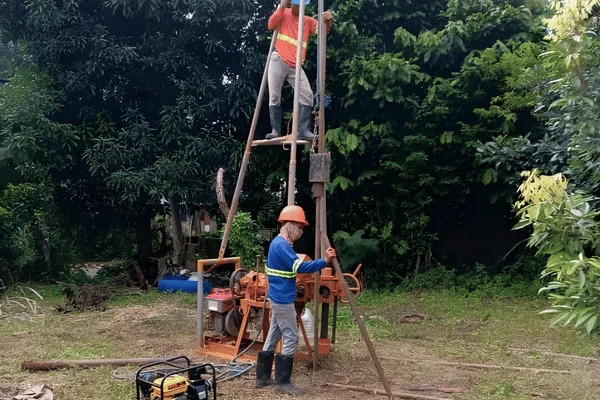
The Standard Penetration Test begins with borehole drilling at designated locations based on project requirements. Boreholes are drilled to specific depths depending on the structure type and expected load conditions. Proper preparation ensures that the Standard Penetration Test reflects true subsurface conditions.
Split-spoon sampling process
A split-spoon sampler is lowered into the borehole during the Standard Penetration Test. A standard hammer weight is dropped repeatedly from a fixed height to drive the sampler into the soil. The number of blows required for penetration is carefully recorded.
This blow count forms the N-value, which is a key output of the Standard Penetration Test. Higher N-values indicate denser or stronger soils, while lower values indicate softer or weaker ground conditions.
Data recording and interpretation
Results from the Standard Penetration Test are recorded at regular depth intervals. Engineers interpret these values to classify soil types and estimate engineering properties such as shear strength and bearing capacity.
The Standard Penetration Test data also supports settlement analysis, helping engineers anticipate how much a structure may sink under load over time.
Importance of Standard Penetration Test for Foundation Design
Foundation design relies heavily on accurate soil data, and the Standard Penetration Test provides one of the most practical sources of this information.
Bearing capacity estimation
The Standard Penetration Test helps estimate soil bearing capacity, which determines how much load the ground can safely support. This is essential for selecting the correct foundation type and preventing structural failure.
Settlement prediction
The Standard Penetration Test assists engineers in predicting settlement behavior. Uneven settlement can lead to cracks, tilting, or structural damage. Data from the Standard Penetration Test helps reduce these risks by improving design accuracy.
Liquefaction assessment
Seismic activity is a major concern in many regions of the Philippines. The Standard Penetration Test is widely used to assess liquefaction potential, especially in sandy soils with high water content. Low resistance values from the Standard Penetration Test may indicate higher liquefaction risk during earthquakes.
Standard Penetration Test and Compliance with Construction Standards
Construction projects require compliance with technical and regulatory standards to ensure safety and approval from authorities. The Standard Penetration Test supports these requirements by providing standardized geotechnical data.
DPWH requirements for soil investigation
The Standard Penetration Test is commonly required under geotechnical investigation guidelines used for building permits and infrastructure approval. Compliance is aligned with standards from the Department of Public Works and Highways – Bureau of Research and Standards, which sets requirements for soil testing in construction projects.
International testing standards
The Standard Penetration Test follows established international standards to ensure accuracy and consistency.
- ASTM International provides standardized procedures for soil testing and classification
- AASHTO supports geotechnical testing methods used in infrastructure design
Compliance with these standards ensures that results from the Standard Penetration Test are acceptable for engineering design and regulatory review.
Applications of Standard Penetration Test Results
The Standard Penetration Test is applied across a wide range of construction projects. Each application depends on accurate interpretation of soil resistance data.
Residential construction
For housing projects, the Standard Penetration Test helps determine whether shallow foundations are suitable or if deeper support systems are needed. This prevents structural issues such as uneven settlement.
Commercial buildings
Commercial structures often carry heavier loads. The Standard Penetration Test provides critical input for designing foundations that can support multi-storey buildings, malls, and office structures safely.
Infrastructure development
Roads, bridges, and other large-scale infrastructure rely on the Standard Penetration Test to evaluate soil stability across long distances. This helps engineers design foundations that remain stable under dynamic loads and environmental changes.
Role of Inch-On Materials Testing Laboratory in Standard Penetration Test Services
Inch-On Materials Testing Laboratory is a DPWH-BRS-accredited engineering and construction testing facility established in November 2018. The laboratory provides reliable Standard Penetration Test services as part of its geotechnical investigation offerings.
The company operates as an independent testing laboratory focused on soil, concrete, and foundation evaluation. Each Standard Penetration Test is conducted using calibrated equipment and standardized procedures to ensure accuracy and consistency.
Field teams perform the Standard Penetration Test directly at project sites, while laboratory engineers analyze results to support foundation design recommendations. This combined approach ensures that every Standard Penetration Test contributes to safe and efficient construction planning.
Common Soil Conditions Identified Through Standard Penetration Test
The Standard Penetration Test helps identify various subsurface conditions that affect construction safety and design.
Soft clay layers
Low resistance values in the Standard Penetration Test often indicate soft clay layers. These soils may compress under load, leading to settlement issues if not properly addressed in design.
Loose sandy soils
The Standard Penetration Test can detect loose sand formations that may require compaction or deep foundation systems for structural stability.
Variable soil stratification
Changes in Standard Penetration Test results across depth levels indicate layered soil conditions. This variation must be considered during foundation design to avoid uneven performance.
High groundwater influence
The Standard Penetration Test also reflects changes in soil behavior caused by groundwater presence. Saturated soils often show reduced resistance, affecting load-bearing capacity.
Advantages of Standard Penetration Test for Construction Projects
The Standard Penetration Test remains widely used because of its practical advantages in field investigations.
The Standard Penetration Test is cost-effective compared to more complex laboratory-based methods. It also provides direct measurements under actual site conditions, making results highly relevant for engineering design.
Another advantage of the Standard Penetration Test is its adaptability across different soil types. Whether dealing with clay, sand, or mixed soil layers, the Standard Penetration Test provides usable data for analysis.
Limitations of Standard Penetration Test
While the Standard Penetration Test is highly useful, it also has limitations that engineers consider during interpretation.
The Standard Penetration Test may be affected by operator technique, equipment variation, and soil disturbance during sampling. These factors can influence N-values and require careful analysis.
Despite these limitations, the Standard Penetration Test remains a primary tool in geotechnical investigation due to its reliability and widespread acceptance in engineering practice.
Takeaway
The Standard Penetration Test continues to serve as a critical method for understanding subsurface soil conditions and guiding foundation design. Its role in geotechnical soil investigation supports safer construction practices across residential, commercial, and infrastructure projects.
Through accurate execution of the Standard Penetration Test, engineers gain essential data on soil strength, settlement behavior, and liquefaction potential. These insights help reduce structural risks and improve long-term performance of built environments.
With accredited services from Inch-On Materials Testing Laboratory, each Standard Penetration Test contributes to dependable engineering decisions supported by standardized procedures and industry compliance.
Frequently Asked Questions (FAQ)
What is a Standard Penetration Test?
The Standard Penetration Test is a field test used to measure soil resistance by counting the number of hammer blows required to drive a sampler into the ground.
Why is the Standard Penetration Test important?
The Standard Penetration Test provides data used for foundation design, soil classification, and assessment of bearing capacity and settlement behavior.
Where is the Standard Penetration Test applied?
The Standard Penetration Test is used in residential buildings, commercial structures, roads, bridges, and other infrastructure projects.
Does the Standard Penetration Test detect weak soil?
Yes, the Standard Penetration Test identifies low-resistance zones such as soft clay and loose sand that may require foundation reinforcement.
Is the Standard Penetration Test required for construction permits?
Many projects require geotechnical reports that include the Standard Penetration Test, especially for compliance with DPWH-BRS Philippines construction standards authority guidelines.