Every successful construction project starts with a strong foundation. Whether constructing a residential tower, commercial complex, bridge, industrial facility, or infrastructure project, foundation performance directly affects structural safety, durability, and long-term stability. Pile foundations are often selected when surface soils cannot adequately support structural loads, making proper pile assessment a critical step before project completion.
A Pile Integrity and Pile Dynamic Test provides engineers, contractors, and project owners with valuable information regarding the condition and performance of foundation piles. These testing methods help verify that installed piles meet project requirements and perform as intended under actual site conditions.
As a DPWH-BRS accredited engineering and construction laboratory, Inch-On Materials Testing Laboratory provides professional testing services that help ensure foundation reliability through accurate assessment and internationally recognized testing procedures based on ASTM and AASHTO standards.
Understanding Pile Foundations and Their Importance
Pile foundations are deep foundation elements designed to transfer structural loads from buildings and infrastructure to stronger soil layers or rock formations beneath weaker surface soils. They are commonly used when shallow foundations cannot safely support the anticipated loads.
Pile foundations play a crucial role in numerous construction projects, including high-rise buildings, warehouses, bridges, marine facilities, power plants, and transportation infrastructure. Since piles often remain hidden beneath the ground after installation, testing becomes necessary to verify their quality and performance.
Even minor defects within a pile can affect its load-bearing capability. Construction errors, material inconsistencies, soil variations, and installation challenges may lead to hidden weaknesses that cannot be detected through visual inspection alone. This is where a Pile Integrity and Pile Dynamic Test becomes highly valuable.
By conducting a Pile Integrity and Pile Dynamic Test, project stakeholders gain confidence that the foundation system meets design expectations and safety requirements.
What Is a Pile Integrity and Pile Dynamic Test?
A Pile Integrity and Pile Dynamic Test refers to specialized foundation testing methods used to evaluate pile quality and performance.
Pile Integrity Testing focuses on identifying structural defects, discontinuities, cracks, voids, necking, or changes in pile geometry. It provides information about the overall condition of the pile shaft and helps determine whether construction quality meets project specifications.
Pile Dynamic Testing evaluates pile capacity and performance under dynamic loading conditions. During testing, sensors measure pile response to controlled impacts, allowing engineers to assess load-bearing characteristics and driving performance.
Although both methods evaluate pile foundations, they serve different purposes. A Pile Integrity and Pile Dynamic Test combination offers a comprehensive understanding of foundation quality, ensuring that piles are both structurally sound and capable of supporting design loads.
Why Pile Integrity and Pile Dynamic Test Are Critical for Construction Projects
Detecting Hidden Defects
Many pile defects remain concealed beneath the ground and cannot be identified through ordinary inspection methods. Issues such as cracks, honeycombing, voids, soil inclusions, and pile necking may significantly reduce foundation performance.
A Pile Integrity and Pile Dynamic Test helps detect these hidden problems early. Early identification allows corrective actions before structural loads are applied, reducing future risks.
Verifying Foundation Quality
Construction projects involve significant investments. Ensuring foundation quality is essential to protect those investments.
A Pile Integrity and Pile Dynamic Test confirms whether piles have been installed correctly and comply with engineering requirements. The testing process provides objective data that supports quality assurance programs and project documentation.
Improving Project Safety
Foundation failures can result in costly repairs, project delays, and safety hazards. Proper testing helps minimize these risks by identifying potential concerns before they affect the structure.
Conducting a Pile Integrity and Pile Dynamic Test supports safer construction practices and contributes to long-term structural stability.
Reducing Costly Remedial Work
Repairing foundation issues after project completion can be expensive and disruptive. Testing piles during construction allows engineers to identify and address problems before they escalate.
A proactive testing approach often saves considerable time and money throughout the project lifecycle.
How a Pile Integrity Test Works
Pile Integrity Testing is commonly performed using a low-strain impact method. This non-destructive testing technique evaluates the continuity of the pile without causing damage.
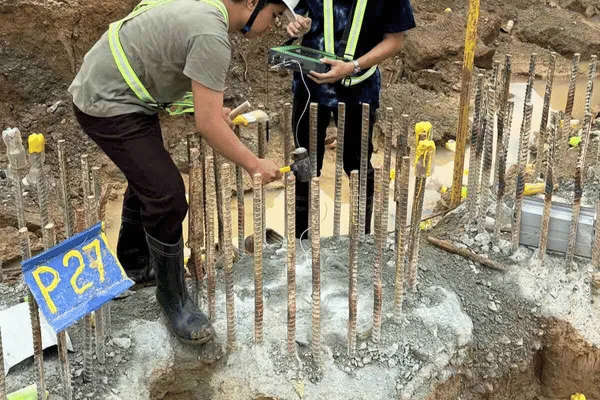
During testing, a technician lightly strikes the pile head using a handheld hammer. Sensitive instruments record the resulting stress waves as they travel through the pile. Reflections generated by changes in pile geometry or material properties are captured and analyzed.
Engineers review the recorded signals to determine whether defects or irregularities exist within the pile. The test can identify issues such as:
- Cracks
- Voids
- Necking
- Bulging
- Changes in cross-sectional area
- Material inconsistencies
One major advantage of a Pile Integrity and Pile Dynamic Test program is that pile integrity testing can be completed quickly and efficiently across numerous piles within a project site.
How a Pile Dynamic Test Works
Pile Dynamic Testing evaluates pile performance during driving operations or through controlled impact loading. The method uses specialized sensors attached to the pile near its head.
These sensors measure force and acceleration generated during impact events. Data collected during testing is processed using advanced analysis software to determine pile behavior and estimated load-bearing capacity.
Pile Dynamic Testing provides valuable information regarding:
- Axial capacity
- Driving stresses
- Hammer performance
- Soil resistance distribution
- Pile integrity indicators
- Installation efficiency
A Pile Integrity and Pile Dynamic Test combination provides engineers with a more complete understanding of foundation performance than either method alone.
This information assists project teams when making decisions regarding pile acceptance, design verification, and construction quality control.
Key Differences Between Pile Integrity and Pile Dynamic Test
Although both methods evaluate foundation piles, several important differences exist.
Pile Integrity Testing primarily focuses on detecting structural defects and evaluating pile continuity. It is generally conducted after pile installation and does not directly determine load-bearing capacity.
Pile Dynamic Testing focuses on assessing pile capacity, driving performance, and load transfer behavior. It provides information about the pile’s ability to support structural loads.
Pile Integrity Testing uses low-strain impact waves generated by light hammer strikes, while Pile Dynamic Testing relies on larger impact forces and sophisticated instrumentation.
When combined, a Pile Integrity and Pile Dynamic Test program offers a thorough assessment of both structural condition and functional performance.
Common Construction Projects That Require Pile Integrity and Pile Dynamic Test
Numerous construction sectors rely on Pile Integrity and Pile Dynamic Test services to verify foundation performance.
High-rise buildings often require deep foundations capable of supporting substantial structural loads. Testing confirms that installed piles satisfy design criteria.
Commercial developments such as shopping centers, office buildings, and mixed-use properties benefit from foundation verification before project completion.
Industrial facilities including manufacturing plants, warehouses, and processing facilities frequently require pile foundations due to heavy operational loads.
Bridge construction projects depend heavily on pile foundations to support piers, abutments, and elevated structures. Proper testing helps ensure long-term durability.
Marine facilities such as ports, wharves, and coastal structures face unique environmental challenges. Pile Integrity and Pile Dynamic Test services assist engineers in evaluating foundation reliability under demanding conditions.
Government infrastructure projects, transportation facilities, renewable energy installations, and utility developments also commonly require pile testing.
Benefits of Conducting Pile Integrity and Pile Dynamic Test Through a DPWH-BRS Accredited Laboratory
Reliable and Accurate Results
Accredited laboratories follow strict quality procedures to ensure dependable testing outcomes. Accurate data supports sound engineering decisions and project compliance.
Compliance with Industry Standards
Testing performed according to ASTM and AASHTO standards provides consistency and reliability. These standards help ensure that results are recognized by project stakeholders and regulatory authorities.
Qualified Technical Professionals
Experienced engineers and technicians understand proper testing procedures, equipment operation, and data interpretation. Their expertise contributes to accurate evaluations and meaningful recommendations.
Enhanced Project Confidence
A professionally conducted Pile Integrity and Pile Dynamic Test provides project owners, consultants, and contractors with confidence regarding foundation performance and quality.
Why Choose Inch-On Materials Testing Laboratory for Pile Integrity and Pile Dynamic Test
Inch-On Materials Testing Laboratory has established itself as a trusted engineering and construction laboratory since 2018. As a DPWH-BRS accredited facility, the laboratory provides independent testing services focused on quality verification and structural assessment.
The laboratory specializes in evaluating soil, construction materials, concrete, and foundation systems using advanced testing equipment and recognized methodologies.
Clients benefit from:
- DPWH-BRS accreditation
- Independent and objective testing services
- Compliance with ASTM and AASHTO standards
- Experienced technical personnel
- Modern testing equipment
- Comprehensive field and laboratory capabilities
Through professional Pile Integrity and Pile Dynamic Test services, Inch-On Materials Testing Laboratory helps contractors, developers, engineers, and project owners maintain confidence in foundation performance.
Best Practices Before Scheduling a Pile Integrity and Pile Dynamic Test
Proper preparation contributes to successful testing outcomes.
Project teams should coordinate testing schedules early to avoid delays. Site access should be arranged to allow safe and efficient equipment operation.
Relevant design documents, pile installation records, and construction reports should be made available to testing personnel. These records help engineers understand project requirements and interpret results accurately.
Pile heads should be prepared according to testing requirements to ensure reliable data collection. Communication among contractors, consultants, and laboratory personnel also supports efficient testing activities.
Planning ahead allows a Pile Integrity and Pile Dynamic Test program to be completed smoothly while minimizing disruptions to ongoing construction operations.
The Future of Foundation Quality Assurance Through Advanced Testing
Construction projects continue to become larger and more technically demanding. As structural requirements increase, the importance of foundation quality assurance also grows.
Modern testing technologies provide engineers with increasingly detailed information regarding pile performance and foundation behavior. Advanced sensors, digital analysis systems, and sophisticated software tools continue to improve testing accuracy and efficiency.
A Pile Integrity and Pile Dynamic Test remains one of the most effective methods for evaluating foundation quality and supporting informed engineering decisions.
Professional laboratories play a critical role by providing independent verification and reliable data that support safe, efficient, and successful construction projects.
Takeaway
Pile foundations form the backbone of many modern structures, making foundation verification an essential component of construction quality assurance. A Pile Integrity and Pile Dynamic Test provides valuable insight into pile condition, structural continuity, and load-bearing performance.
These testing methods help identify hidden defects, verify installation quality, support project safety, and reduce the likelihood of costly foundation-related issues. By combining integrity testing with dynamic load assessment, project teams gain a comprehensive understanding of foundation performance.
As a DPWH-BRS accredited engineering and construction laboratory, Inch-On Materials Testing Laboratory delivers reliable testing services based on ASTM and AASHTO standards. Through professional Pile Integrity and Pile Dynamic Test services, Inch-On helps ensure that construction projects are built on a foundation of quality, accuracy, and confidence.
Frequently Asked Questions About Pile Integrity and Pile Dynamic Test
What is the purpose of a Pile Integrity and Pile Dynamic Test?
A Pile Integrity and Pile Dynamic Test helps evaluate pile condition, identify defects, verify installation quality, and assess load-bearing performance. These tests provide engineers with critical information about foundation reliability.
When should a Pile Integrity Test be performed?
Pile Integrity Testing is typically performed after pile installation and before significant structural loading occurs. The exact timing depends on project requirements and construction schedules.
How does a Pile Dynamic Test determine pile capacity?
Pile Dynamic Testing measures force and acceleration during controlled impact events. Engineers analyze the collected data to estimate pile capacity, soil resistance, and driving performance.
Are Pile Integrity and Pile Dynamic Test non-destructive?
Pile Integrity Testing is considered non-destructive because it does not damage the pile. Pile Dynamic Testing generally does not cause structural damage when conducted according to proper procedures.
Which industries commonly require pile testing services?
Industries that frequently require Pile Integrity and Pile Dynamic Test services include commercial construction, residential development, industrial facilities, transportation infrastructure, marine construction, utilities, and government projects.
Why is it important to work with a DPWH-BRS accredited testing laboratory?
DPWH-BRS accredited laboratories follow recognized quality standards and testing procedures. Accreditation helps ensure reliable results that support engineering decisions and regulatory compliance.
How long does a typical pile testing process take?
The duration depends on project size, number of piles, site conditions, and testing requirements. Many pile integrity assessments can be completed quickly, while dynamic testing may require additional preparation and analysis.
Can pile testing help prevent structural failures?
Yes. A Pile Integrity and Pile Dynamic Test can identify defects, installation issues, and capacity concerns before they affect structural performance. Early detection supports safer and more reliable construction outcomes.