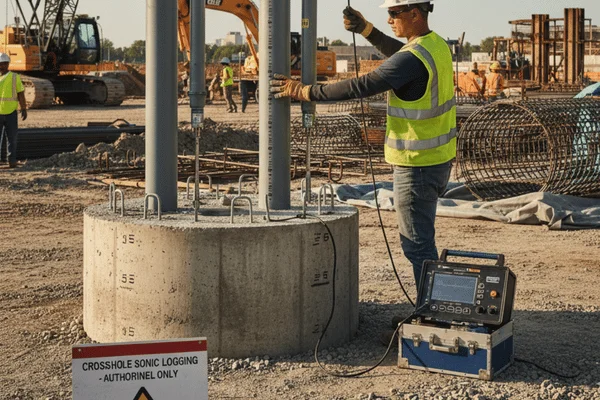
Construction projects depend heavily on the quality and integrity of their foundations. Whether the project involves a high-rise building, bridge, industrial facility, or public infrastructure, the strength of the foundation directly affects the long-term performance of the structure. Hidden defects within bored piles and drilled shafts can compromise structural stability and create costly challenges during and after construction.
A Crosshole Sonic Logging Test is one of the most trusted methods for evaluating the internal condition of deep foundations. This advanced testing procedure allows engineers and contractors to verify concrete quality throughout the entire foundation element. By identifying potential defects before they become major concerns, a Crosshole Sonic Logging Test supports safer construction practices and better project outcomes.
Project owners, developers, consultants, and contractors increasingly rely on a Crosshole Sonic Logging Test to validate foundation quality. The detailed information provided by this testing method helps reduce uncertainty and supports informed engineering decisions.
What Is a Crosshole Sonic Logging Test?
A Crosshole Sonic Logging Test is a non-destructive testing method used to assess the internal integrity of concrete foundations. It is commonly performed on drilled shafts, bored piles, caissons, and other deep foundation systems where internal defects may not be visible from the surface.
The process uses ultrasonic signals transmitted between access tubes embedded within the foundation during construction. By measuring the travel time and quality of these signals, engineers can determine whether the concrete is consistent and free from significant anomalies.
Unlike visual inspections, a Crosshole Sonic Logging Test examines conditions inside the foundation. This allows engineers to identify issues such as voids, honeycombing, inclusions, contamination, and poorly consolidated concrete that could affect structural performance.
Because of its accuracy and reliability, a Crosshole Sonic Logging Test is widely accepted for quality assurance programs across major construction projects.
How a Crosshole Sonic Logging Test Works
Installation of Access Tubes
The first step in a Crosshole Sonic Logging Test involves installing access tubes within the reinforcement cage before concrete placement. These tubes remain embedded within the foundation and serve as channels for the testing equipment.
Proper tube installation is important because it allows technicians to collect accurate readings across multiple sections of the pile. The number and placement of tubes depend on the pile diameter and project requirements.
Ultrasonic Signal Transmission
During the testing process, a transmitter and receiver are lowered into adjacent tubes filled with water. The transmitter emits ultrasonic waves that travel through the concrete to the receiver.
As the equipment moves along the length of the foundation, measurements are recorded at multiple depths. The resulting data provides valuable information about concrete consistency and internal quality.
Data Collection and Analysis
A Crosshole Sonic Logging Test generates detailed sonic profiles and waterfall plots. These graphical representations help engineers identify areas where signal strength changes or travel times increase.
Sections showing abnormal readings may indicate defects or variations in concrete quality. Engineers review the data carefully to determine whether corrective action is necessary.
Key Benefits of a Crosshole Sonic Logging Test
Detects Internal Concrete Defects
One of the greatest advantages of a Crosshole Sonic Logging Test is its ability to detect hidden defects. Problems such as voids, honeycombing, segregation, and inclusions can significantly affect foundation performance if left undetected.
Early identification allows project teams to address issues before construction progresses further.
Evaluates the Entire Foundation Depth
A Crosshole Sonic Logging Test provides information throughout the full length of the foundation. This level of coverage helps engineers gain confidence that the pile performs as intended from top to bottom.
Supports Construction Quality Control
Quality control is essential for successful construction projects. A Crosshole Sonic Logging Test provides objective data that can be used to verify workmanship and concrete quality.
The information obtained helps contractors demonstrate compliance with project specifications and engineering requirements.
Reduces Future Structural Risks
Foundation defects can lead to costly repairs, delays, and structural concerns. A Crosshole Sonic Logging Test helps reduce these risks by identifying potential issues before they become serious problems.
Common Defects Identified Through a Crosshole Sonic Logging Test
Several types of defects can be detected through a Crosshole Sonic Logging Test.
Voids are among the most common concerns. These empty spaces can develop when concrete does not completely fill all portions of the pile.
Honeycombing may occur when concrete is not properly consolidated during placement. This condition creates pockets of air and weakens the structure.
Segregation can happen when aggregate separates from the cement mixture, resulting in inconsistent concrete quality.
Soil inclusions and contamination may also occur during construction. These materials can affect the load-carrying capacity of the foundation if not detected.
Necking, or localized reductions in pile diameter, is another issue that a Crosshole Sonic Logging Test can identify. Detecting these conditions early supports timely corrective measures.
Projects That Commonly Require a Crosshole Sonic Logging Test
High-Rise Buildings
Tall structures place significant loads on their foundations. A Crosshole Sonic Logging Test helps verify that piles can safely support these demands.
Bridge Foundations
Bridges rely on strong and dependable deep foundations. Testing ensures that critical structural elements meet design expectations.
Transportation Infrastructure
Roads, rail systems, flyovers, and transit facilities often require extensive foundation testing to maintain safety and performance.
Industrial Facilities
Manufacturing plants, warehouses, and energy facilities frequently use deep foundations. A Crosshole Sonic Logging Test provides confidence that these structures are supported by sound concrete elements.
Marine and Port Developments
Marine environments create unique challenges for construction. Testing helps confirm the integrity of piles exposed to demanding conditions.
Government Infrastructure Projects
Public infrastructure projects often require comprehensive quality assurance measures. A Crosshole Sonic Logging Test helps satisfy these requirements while supporting long-term performance.
Crosshole Sonic Logging Test vs Other Foundation Integrity Testing Methods
Comparison with Low Strain Integrity Testing
Low Strain Integrity Testing is another common method used to evaluate foundations. While useful for many applications, it may be influenced by pile length, geometry, and surrounding soil conditions.
A Crosshole Sonic Logging Test provides a more direct assessment of internal concrete quality because ultrasonic signals pass through the foundation itself.
Accuracy and Defect Detection Capabilities
The detailed information obtained from a Crosshole Sonic Logging Test makes it particularly valuable for large and critical projects. Engineers can evaluate specific sections of the pile and identify potential defects with greater confidence.
Limitations and Considerations
A Crosshole Sonic Logging Test requires access tubes to be installed before concrete placement. Proper planning during construction is therefore essential to ensure successful testing.
Meeting Philippine Construction Standards Through Proper Foundation Testing
Construction quality remains a major priority across the Philippines. Projects must meet strict engineering and regulatory requirements to ensure public safety and long-term durability.
A Crosshole Sonic Logging Test supports compliance efforts by providing documented evidence of foundation integrity. Contractors and developers can use testing results to demonstrate that foundations meet project specifications.
Independent testing laboratories play an important role in this process by providing objective assessments and reliable reporting.
Why Accuracy Is Essential When Testing Deep Foundations
Deep foundation defects are often difficult to identify through visual inspection alone. Without accurate testing, hidden problems may remain undetected until significant structural concerns emerge.
A Crosshole Sonic Logging Test helps reduce uncertainty by providing detailed information about the condition of the foundation. Accurate testing supports better decision-making and helps protect project investments.
Correcting foundation problems after construction can be expensive and time-consuming. Early detection through a Crosshole Sonic Logging Test helps avoid these challenges while supporting efficient project delivery.
Why Choose Inch-On Materials Testing Laboratory for Crosshole Sonic Logging Test Services
Inch-On Materials Testing Laboratory is a DPWH-BRS accredited Engineering and Construction Laboratory established in 2018. The laboratory specializes in verifying the quality of soil, construction materials, concrete, and foundation systems through reliable testing services.
For projects requiring a Crosshole Sonic Logging Test, Inch-On provides experienced technical personnel, specialized equipment, and professional evaluation services. Every testing procedure follows recognized ASTM and AASHTO standards to ensure dependable results.
As an independent testing laboratory, Inch-On offers objective assessments that help contractors, developers, consultants, and project owners make informed decisions regarding foundation quality.
The laboratory’s expertise extends beyond a Crosshole Sonic Logging Test to include comprehensive field and laboratory testing solutions that support construction quality assurance from start to finish.
Additional Testing Services Available at Inch-On Materials Testing Laboratory
Beyond a Crosshole Sonic Logging Test, Inch-On Materials Testing Laboratory offers a wide range of construction testing services.
These services include Field Density Testing, soil testing, concrete testing, field testing, and laboratory testing for construction materials. Each service is designed to evaluate quality, performance, and compliance with project requirements.
Comprehensive testing programs help project teams maintain quality standards throughout every phase of construction.
Building Stronger Foundations with a Crosshole Sonic Logging Test
Reliable foundations are essential for safe and successful construction. A Crosshole Sonic Logging Test provides detailed information that helps engineers verify concrete integrity, identify hidden defects, and support quality assurance objectives.
For projects involving deep foundations, a Crosshole Sonic Logging Test serves as an important tool for reducing risk and improving confidence in structural performance. By working with an experienced and accredited testing laboratory such as Inch-On Materials Testing Laboratory, project teams gain access to accurate testing services that support long-term construction success.
Frequently Asked Questions About Crosshole Sonic Logging Test
What is the primary purpose of a Crosshole Sonic Logging Test?
A Crosshole Sonic Logging Test is performed to evaluate the internal condition of deep concrete foundations and identify potential defects such as voids, honeycombing, segregation, and inclusions.
When should a Crosshole Sonic Logging Test be performed?
A Crosshole Sonic Logging Test is typically conducted after the concrete has achieved sufficient strength and before major construction activities continue above the foundation.
What types of foundations can be tested using CSL?
The test is commonly used for bored piles, drilled shafts, caissons, and other deep foundation elements equipped with access tubes.
What defects can a Crosshole Sonic Logging Test detect?
A Crosshole Sonic Logging Test can identify voids, honeycombing, soil contamination, segregation, necking, and areas of poor concrete quality.
How accurate is a Crosshole Sonic Logging Test?
A Crosshole Sonic Logging Test is widely regarded as one of the most accurate methods available for evaluating the internal integrity of deep foundations.
Is a Crosshole Sonic Logging Test required for all bored piles?
Not all projects require this testing method. Requirements depend on project specifications, engineering recommendations, regulatory requirements, and foundation design.
How long does the testing process take?
The duration depends on the number of piles, pile depth, and project conditions. Many individual piles can be tested within a relatively short period once preparation is complete.
Why should I work with a DPWH-accredited testing laboratory?
A DPWH-accredited laboratory provides testing services that meet recognized industry requirements. This helps ensure reliable results and supports project compliance and quality assurance objectives.