Structural quality cannot be judged by surface appearance alone. Concrete may look solid from the outside while cracks, voids, honeycombing, or weak areas remain hidden below the surface. These defects may affect durability, load performance, maintenance costs, and long-term safety. An Ultrasonic Test gives engineers, contractors, developers, and property owners a non-destructive way to assess material condition without cutting, drilling, or removing large samples.
Inch-On Materials Testing Laboratory provides professional Ultrasonic Test services for construction projects across the Philippines. Established during November 2018, the laboratory serves as an independent testing provider focused on soil, concrete, construction materials, and foundation piles. Its DPWH-BRS accreditation, specialized equipment, and use of applicable ASTM and AASHTO procedures support dependable testing and organized technical reporting.
An Ultrasonic Test sends high-frequency sound waves through a material. Changes across travel time, pulse velocity, and signal behavior may point to internal irregularities. Qualified testing personnel study the readings, compare test locations, and prepare findings that can support engineering decisions. This process helps project teams examine questionable areas while preserving the tested component.
What Is an Ultrasonic Test?
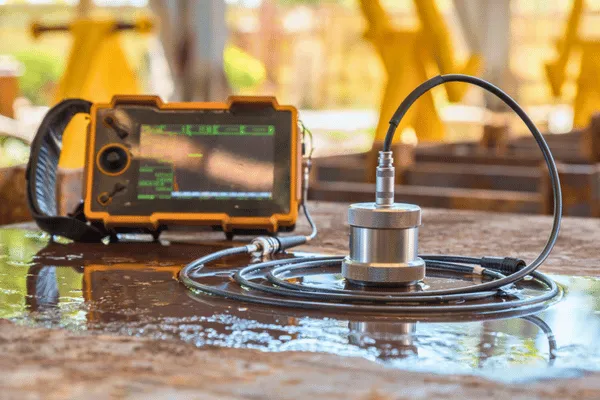
An Ultrasonic Test is a non-destructive testing method that uses high-frequency sound waves to study the internal condition of a material or structural component. A testing device sends an ultrasonic pulse through the selected area. Sensors then receive the pulse and record how quickly it travels, how strongly it arrives, and whether its behavior changes across different test points.
Sound waves usually travel more consistently through solid, uniform material. Cracks, gaps, voids, and other discontinuities may interrupt or slow the signal. Such changes can help trained personnel locate possible problem areas that deserve further review.
An Ultrasonic Test does not automatically provide a complete structural diagnosis. Test data should be reviewed together with structural drawings, project specifications, site observations, material history, and professional engineering judgment. Some cases may also require another method, such as core testing, rebound hammer testing, visual inspection, or pile testing, to confirm the findings.
The non-destructive nature of an Ultrasonic Test makes it valuable for finished buildings, active construction sites, bridges, foundations, walls, slabs, columns, beams, and other components where unnecessary damage should be avoided.
How an Ultrasonic Test Works
The testing process begins with a review of the project, target material, and testing objective. Technicians select suitable test points and prepare the surface so the transducers can make proper contact. A coupling material may be applied between the equipment and the surface to help sound waves pass effectively.
The transmitter sends an ultrasonic pulse through the material. A receiver captures the pulse after it passes through or travels across the test area. The equipment records the pulse travel time and other signal details. Tests are repeated across selected locations to create a useful comparison.
A uniform set of readings may suggest fairly consistent material condition across the tested area. Irregular readings may indicate a possible crack, void, honeycombed zone, poor compaction, or another internal concern. The location, size, depth, and orientation of a defect can affect the signal, which is why careful test planning and qualified interpretation matter.
An Ultrasonic Test may use direct, semi-direct, or indirect transmission, depending on access. Direct transmission places the transmitter and receiver on opposite sides of the material. Semi-direct transmission places them on adjacent surfaces. Indirect transmission places both units on the same surface. Direct transmission often provides strong results, yet site conditions may require another arrangement.
Why Hidden Defects Matter
Hidden defects can affect a structure long before visible symptoms become severe. A small internal crack may grow after repeated loading, vibration, moisture exposure, or temperature changes. Voids may reduce the effective section of a component. Honeycombing can create weak zones and allow water or harmful substances to reach reinforcing steel.
For contractors, a hidden defect can create rework, delay, warranty concerns, or disputes. For developers and property owners, it can lead to higher repair costs and reduced service life. For engineers, incomplete information can make assessment and repair planning more difficult.
An Ultrasonic Test helps reduce uncertainty by supplying measurable data from selected areas. The findings can help project teams decide whether a component appears consistent, whether added testing is needed, or whether repairs should be planned. Early assessment may also limit the extent of corrective work because questionable locations can be identified before wider damage occurs.
Common Defects an Ultrasonic Test May Help Detect
An Ultrasonic Test may help locate several forms of internal irregularity. One common concern is cracking. Internal cracks can reflect sound waves, delay pulse movement, or weaken the received signal. Surface cracks may also affect readings, especially when they cross the test path.
Voids represent another concern. Air gaps or unfilled spaces may interrupt normal wave travel and produce unusual readings. Honeycombing may create similar effects because poorly compacted concrete contains gaps and exposed aggregate pockets.
An Ultrasonic Test may also help identify differences across concrete quality. Variations may result from inconsistent batching, poor compaction, segregation, moisture differences, or curing problems. The test does not always identify the exact cause, yet it can point to areas that differ from surrounding material.
For foundation piles, ultrasonic methods may support checks related to continuity, possible inclusions, voids, or weak zones, depending on the selected procedure and pile design. Proper method selection remains essential because pile length, diameter, reinforcement, access tubes, soil conditions, and project specifications can affect the testing approach.
Major Uses of an Ultrasonic Test for Construction
An Ultrasonic Test can support quality control during new construction. Contractors may use it to assess concrete components that show suspicious surface conditions, poor placement signs, or unexpected test results. Engineers may request ultrasonic readings before accepting completed work or before deciding whether destructive confirmation is necessary.
Existing buildings can also benefit from an Ultrasonic Test. Property owners may need a condition assessment before renovation, expansion, change of use, or repair. Engineers may test selected areas of columns, beams, slabs, and walls to compare material consistency and locate questionable zones.
Bridges, industrial facilities, warehouses, parking structures, schools, hospitals, commercial buildings, and residential developments may require non-destructive assessment for maintenance planning. An Ultrasonic Test can help gather data without causing major disruption to occupied or operational spaces.
Foundation projects may use ultrasonic procedures to support pile quality evaluation. Piles carry major structural loads, so possible defects require careful review. An appropriate Ultrasonic Test can contribute valuable information about pile continuity and internal condition when specified by the engineer or project requirements.
Benefits of an Ultrasonic Test
A major benefit of an Ultrasonic Test is material preservation. The method usually does not require core removal, cutting, or breaking finished surfaces. This can reduce patching work, waste, noise, dust, and disturbance at the project site.
Another benefit is the ability to inspect several selected locations. Technicians can collect readings across a grid or series of test points, which helps compare one area with another. This wider comparison can be useful when a defect does not appear at the surface.
An Ultrasonic Test also supports early decision-making. Project teams can review the findings before committing to major repairs or destructive investigation. Questionable zones can receive focused attention, which may reduce unnecessary work elsewhere.
Technical documentation adds further value. A professional report can record test locations, procedures, observations, readings, and interpreted findings. Such documentation can support quality control files, consultant reviews, repair plans, project acceptance discussions, and future maintenance records.
Speed may also be an advantage. Testing can often be completed with limited disruption, though total duration depends on the number of test points, component access, site preparation, and reporting requirements.
When Should You Request an Ultrasonic Test?
An Ultrasonic Test should be considered whenever internal material condition cannot be confirmed through visual checking alone. Cracking, discoloration, exposed aggregate, honeycombing, hollow sounds, leakage, or poor concrete placement may justify added assessment.
Project teams may also request an Ultrasonic Test before accepting newly completed concrete work. This can be useful when compressive strength results are inconsistent, construction records raise questions, or critical components require added verification.
Older structures may need testing before renovation or repair. Changes to floor loads, structural alterations, equipment installation, or added stories can require a clearer picture of existing material condition.
After an impact, fire, earthquake, flooding event, or heavy vibration, an Ultrasonic Test may support a broader structural review. The test should form part of a complete assessment led by qualified professionals.
Foundation pile testing may be requested after placement, especially when construction issues, concrete supply interruptions, or installation concerns have occurred. The exact test method should match the pile system and approved project specifications.
What Happens During an Ultrasonic Test?
The first step covers project review. Inch-On Materials Testing Laboratory may request drawings, component details, site history, target locations, and the purpose of testing. Clear objectives help determine equipment setup, point spacing, access needs, and reporting format.
Next comes site preparation. Test surfaces may need cleaning, light grinding, or removal of loose coatings. Proper contact between the transducer and the material is important for reliable readings. Technicians mark test points and confirm that the selected areas are safe and accessible.
Equipment setup follows. The ultrasonic device is checked and calibrated based on the procedure. Couplant is applied where required, and the transmitter and receiver are positioned at each test point. Multiple readings may be taken to confirm consistency.
After data collection, the results are reviewed. Technicians compare readings across the tested area and note unusual patterns. The final report may include the test method, equipment details, locations, recorded values, observations, and interpretation. Where necessary, the report may suggest added testing or engineering review.
Factors That Can Affect Ultrasonic Test Results
Several factors can influence readings. Moisture content may affect pulse velocity. Surface roughness can reduce contact quality. Reinforcing bars may alter wave travel, especially when the test path runs parallel to steel. Component thickness, aggregate type, concrete age, temperature, and internal stress can also affect results.
Access conditions determine which transmission arrangement can be used. Opposite-side access allows direct transmission, while single-side access may require an indirect method. Each arrangement has its own strengths and limitations.
Operator skill remains critical. Proper calibration, test-point selection, equipment contact, and data interpretation can affect result quality. A qualified laboratory follows documented procedures and records site conditions that may influence the findings.
An Ultrasonic Test should never be interpreted from a single number without context. Comparison across multiple points, knowledge of the material, and review of project information help produce a more reliable assessment.
Ultrasonic Test Compared With Destructive Testing
An Ultrasonic Test preserves the tested component, while destructive methods remove or damage part of the material. Core testing, for example, provides a physical sample that can be tested for compressive strength, density, or composition. However, coring creates openings that require repair and only represents the sampled location.
Ultrasonic methods can cover more selected points with less damage. They are useful for locating variations and identifying areas that may require focused investigation. Yet ultrasonic readings may not provide the same direct strength value as a laboratory test on a core sample.
Many projects benefit from a combined approach. An Ultrasonic Test can first identify areas with unusual readings. Engineers may then select a smaller number of locations for coring or another confirmation method. This approach can reduce unnecessary damage while still supplying direct evidence where needed.
The correct choice depends on the project goal, structural importance, access, budget, specifications, and engineering requirements.
Why Accreditation Matters for an Ultrasonic Test
Testing results can affect repair decisions, acceptance, compliance, cost, and safety. For that reason, laboratory qualifications matter. A DPWH-BRS accredited laboratory has demonstrated capability across defined testing requirements, personnel, equipment, procedures, and quality controls.
Inch-On Materials Testing Laboratory follows applicable ASTM and AASHTO procedures for its testing services. These recognized standards help support consistent methods, proper documentation, and repeatable practices.
Accreditation does not replace engineering judgment, but it gives clients greater confidence that testing work follows controlled procedures. Contractors, developers, consultants, and government project teams should verify laboratory credentials before commissioning an Ultrasonic Test or any construction material test.
Why Choose Inch-On Materials Testing Laboratory?
Inch-On Materials Testing Laboratory has served the construction sector since November 2018. Its work covers soil, concrete, construction materials, and foundation piles through laboratory and site-based testing.
DPWH-BRS accreditation supports its position as a qualified provider for projects that require recognized testing capability. The laboratory also follows applicable ASTM and AASHTO procedures, helping clients meet project documentation and quality requirements.
Specialized equipment allows Inch-On to perform an Ultrasonic Test without unnecessary damage to the structure. Its technicians collect data from selected locations, review the results, and prepare reports that engineers and project teams can use for further assessment.
Independent testing also supports objective quality review. Inch-On focuses on measurable results, clear observations, and organized reporting rather than assumptions based only on appearance.
Service availability across the Philippines makes Inch-On a practical choice for developers, contractors, engineers, property owners, and government project teams seeking dependable construction material testing support.
How an Ultrasonic Test Supports Better Project Decisions
Construction decisions should be based on reliable evidence. An Ultrasonic Test adds measurable data to visual observations and project records. It can help determine whether material condition appears consistent, whether a suspicious area deserves further study, or whether corrective work should be considered.
For new projects, testing supports quality assurance and acceptance review. For existing structures, it supports maintenance, rehabilitation, and renovation planning. For foundation work, an Ultrasonic Test can contribute to pile condition assessment when the method suits the design and specification.
The greatest value comes from proper planning and professional interpretation. Testing should focus on clear objectives, suitable locations, and methods that match the material. Results should then be reviewed with other available evidence before final decisions are made.
Request an Ultrasonic Test From Inch-On Materials Testing Laboratory
Hidden defects should not be ignored simply because they cannot be seen. An Ultrasonic Test offers a practical, non-destructive way to assess concrete, structural components, and selected foundation applications without causing major damage.
Inch-On Materials Testing Laboratory provides professional testing services backed by DPWH-BRS accreditation, specialized equipment, applicable ASTM and AASHTO procedures, and experience across laboratory and site work. Its technical reports help contractors, developers, engineers, and property owners review possible cracks, voids, honeycombing, and material inconsistencies.
Share your project details, target components, site location, drawings, and testing goals with Inch-On Materials Testing Laboratory. A properly planned Ultrasonic Test can give your project team useful data for quality control, repair planning, acceptance review, and long-term asset care.
Frequently Asked Questions About an Ultrasonic Test
What is the purpose of an Ultrasonic Test?
An Ultrasonic Test uses high-frequency sound waves to assess material consistency and locate possible internal defects. It can support checks for cracks, voids, honeycombing, weak zones, and other discontinuities without major damage to the tested component.
Can an Ultrasonic Test detect cracks inside concrete?
Yes, an Ultrasonic Test may detect signs of internal cracking through changes across pulse travel time or signal behavior. Results require professional interpretation, and some cases may need confirmation through another testing method.
Does an Ultrasonic Test damage concrete?
The procedure is non-destructive. It usually does not require drilling, cutting, or core removal. Minor surface preparation may be needed to create proper contact between the equipment and concrete.
Can an Ultrasonic Test find honeycombing and voids?
An Ultrasonic Test may help locate areas where honeycombing, voids, or poor compaction affect sound-wave travel. Unusual readings can guide added assessment or focused confirmation.
Is an Ultrasonic Test suitable for foundation piles?
Ultrasonic methods may support pile condition assessment when the selected procedure matches the pile design, access provisions, and project specifications. Engineers should confirm the proper method for each pile system.
How long does an Ultrasonic Test take?
Testing time depends on component size, number of test points, site access, surface condition, equipment setup, and required documentation. A small area may be completed quickly, while large or complex projects require more time.
Does an Ultrasonic Test replace core testing?
No single method suits every purpose. An Ultrasonic Test is useful for non-destructive comparison and defect screening, while core testing provides a physical sample for direct laboratory analysis. Engineers may recommend both methods for a complete assessment.
What information should be prepared before testing?
Clients should prepare structural drawings, project specifications, component dimensions, site history, target locations, access details, and the main testing objective. This information helps the laboratory plan the Ultrasonic Test correctly.
Why choose a DPWH-BRS accredited laboratory?
Accreditation supports confidence that the laboratory has qualified personnel, suitable equipment, documented procedures, and quality controls for approved testing services. It also helps meet project and regulatory documentation requirements.
Does Inch-On offer Ultrasonic Test services across the Philippines?
Yes. Inch-On Materials Testing Laboratory provides professional testing support for construction projects across the Philippines, subject to project scope, site conditions, and scheduling.