Standard Penetration Test plays a central role in geotechnical engineering for understanding subsurface soil conditions before construction begins. Standard Penetration Test provides engineers and designers with direct field data that reflects soil density, strength, and consistency at different depths.
Standard Penetration Test is widely applied across residential, commercial, and infrastructure projects where foundation stability depends on accurate ground assessment. Standard Penetration Test results guide decisions that affect structural safety, construction cost planning, and long-term performance of built structures.
Standard Penetration Test holds particular importance within Philippine construction environments due to variable soil conditions and seismic activity. Reliable interpretation of Standard Penetration Test data supports safer foundation design and reduces risks associated with weak or unstable ground layers.
Role of Geotechnical Soil Investigation in Construction Projects
Geotechnical soil investigation establishes the physical behavior of soil layers beneath a proposed structure. Standard Penetration Test forms a core part of geotechnical soil investigation programs since it provides measurable resistance values from actual field conditions.
Standard Penetration Test data helps engineers understand whether soil layers can support structural loads or require improvement before construction proceeds. Soil-related failures such as uneven settlement or tilting often result from insufficient ground investigation.
Construction planning benefits greatly from Standard Penetration Test results since foundation systems depend on accurate subsurface characterization. Projects without proper soil investigation face higher uncertainty during structural design and execution stages.
What is Standard Penetration Test (SPT)?
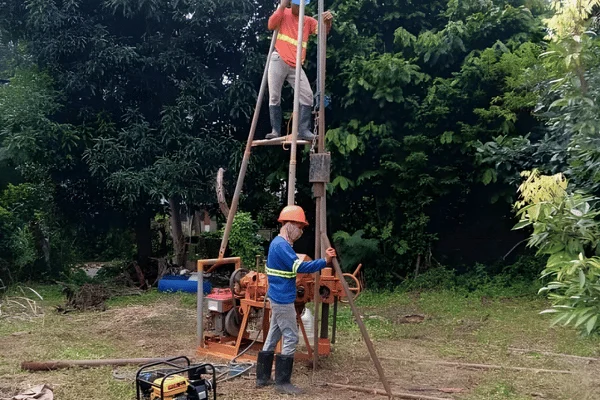
Standard Penetration Test is a field-based soil testing method conducted inside boreholes during geotechnical investigation. Standard Penetration Test measures soil resistance by driving a split-spoon sampler into the ground using a standard hammer system.
Standard Penetration Test produces an N-value, which represents the number of hammer blows required to advance the sampler through a specific soil depth interval. Higher N-values indicate denser or stronger soil conditions, while lower values indicate softer or looser materials.
Standard Penetration Test applies across different soil types such as clay, silt, sand, and mixed deposits. Engineers rely on Standard Penetration Test results to estimate bearing capacity and assess settlement behavior of foundation soils.
Standard Penetration Test Procedure
Standard Penetration Test begins with borehole drilling at selected test locations based on project requirements. Drilling continues until the target depth or soil layer of interest is reached.
Standard Penetration Test then involves lowering a split-spoon sampler into the borehole. A standard hammer with controlled energy is repeatedly dropped to drive the sampler into the soil.
Standard Penetration Test records the number of hammer blows required for penetration over a defined interval, typically measured in three segments. The resulting N-value reflects soil resistance at that specific depth.
Standard Penetration Test also includes retrieval of soil samples from the sampler for further classification and laboratory analysis. These samples help confirm soil type and consistency observed during field testing.
Interpretation of Standard Penetration Test Results
Standard Penetration Test results are interpreted using N-values that reflect soil density and strength. Low N-values typically indicate soft clay or loose sand conditions that may require ground improvement or deeper foundations.
Standard Penetration Test results with moderate N-values often correspond to medium-dense soils suitable for certain shallow foundation systems, depending on structural loads.
Standard Penetration Test results with high N-values indicate dense soil or stiff layers that can support higher structural loads with reduced settlement risk.
Standard Penetration Test data also supports evaluation of liquefaction potential in sandy soils under seismic loading conditions. This analysis is essential for safe foundation design within earthquake-prone regions.
Engineering Applications of Standard Penetration Test Data
Standard Penetration Test serves multiple engineering functions during foundation design and construction planning. Standard Penetration Test results help engineers determine suitable foundation types such as shallow footings, mat foundations, or deep pile systems.
Standard Penetration Test provides input values for estimating allowable soil bearing capacity, which directly affects structural load distribution design.
Standard Penetration Test also assists in identifying weak soil zones that may require soil improvement techniques before construction begins. These zones often appear as low-resistance layers within borehole profiles.
Standard Penetration Test contributes to settlement analysis by helping engineers predict how soil will compress under structural loads over time.
Compliance with DPWH-BRS and International Standards
Standard Penetration Test procedures follow established engineering standards such as ASTM D1586 and AASHTO guidelines. These standards define equipment specifications, testing procedures, and interpretation methods for consistent results.
Standard Penetration Test compliance ensures that soil investigation reports meet requirements for engineering design approval and permitting processes.
Standard Penetration Test results are also aligned with DPWH-BRS requirements for construction projects within the Philippines. Regulatory compliance supports safe infrastructure development and standardized reporting practices.
Field Testing vs Laboratory Testing in Soil Investigation
Standard Penetration Test belongs to field testing activities performed directly at construction sites. Field testing captures real-time soil behavior under natural ground conditions.
Standard Penetration Test data is often paired with laboratory testing results to provide a complete soil profile evaluation. Laboratory testing examines physical and mechanical properties of soil samples collected during field operations.
Standard Penetration Test supports immediate evaluation of soil resistance, while laboratory testing provides detailed classification and strength parameters. Combined results improve accuracy in foundation design recommendations.
Common Soil Challenges in Philippine Construction Sites
Standard Penetration Test frequently reveals challenging ground conditions across many construction sites within the Philippines. Soft clay layers are common and often show low resistance values during Standard Penetration Test procedures.
Standard Penetration Test may also detect loose sandy deposits that present liquefaction risks during seismic events. These conditions require careful foundation planning and engineering mitigation.
Standard Penetration Test results can highlight groundwater influence on soil strength, especially in coastal or low-lying areas where saturation reduces stability.
Standard Penetration Test plays a key role in identifying these risks early, allowing engineers to adjust foundation systems before construction begins.
Role of Inch-On Materials Testing Laboratory in Standard Penetration Test and Soil Investigation
Standard Penetration Test services provided by Inch-On Materials Testing Laboratory support a wide range of construction and engineering projects.
Standard Penetration Test operations are performed using calibrated field equipment aligned with ASTM and AASHTO standards. The laboratory ensures that every Standard Penetration Test result reflects accurate soil resistance measurements for engineering use.
Standard Penetration Test data collected by the laboratory supports residential, commercial, and infrastructure development projects that require reliable foundation design input.
Standard Penetration Test reporting also assists compliance with DPWH-BRS requirements, helping project stakeholders meet regulatory standards for construction safety and approval processes.
Standard Penetration Test combined with other geotechnical services from the laboratory provides a complete understanding of subsurface conditions before construction activities proceed.
Why Accurate Standard Penetration Test Results Matter for Construction Safety
Standard Penetration Test results directly influence foundation design decisions that affect structural stability. Incorrect interpretation or missing Standard Penetration Test data can lead to settlement problems or structural distress.
Standard Penetration Test improves cost efficiency by supporting balanced foundation design. Overestimation of soil strength may lead to unsafe under-design, while underestimation may result in unnecessary construction expenses.
Standard Penetration Test strengthens engineering confidence during project planning by providing measurable field data rather than assumptions.
Standard Penetration Test also supports long-term structural performance by ensuring foundation systems match actual soil conditions at site locations.
Takeaway
Standard Penetration Test remains one of the most important methods for evaluating soil conditions in geotechnical engineering. Standard Penetration Test provides essential field data that supports foundation design, construction planning, and structural safety.
Standard Penetration Test becomes even more critical in regions with variable soil conditions and seismic activity, where reliable ground information directly affects building performance.
Standard Penetration Test, combined with professional geotechnical investigation services from accredited laboratories such as Inch-On Materials Testing Laboratory, ensures that construction projects are built on accurate and verified soil data.
Standard Penetration Test continues to serve as a foundation for safe, efficient, and standards-compliant construction practices across engineering projects.
Frequently Asked Questions (FAQ)
What is Standard Penetration Test used for?
Standard Penetration Test is used to evaluate soil strength, density, and consistency for foundation design and geotechnical analysis.
Why is Standard Penetration Test important in construction?
Standard Penetration Test helps engineers assess whether soil can safely support structural loads and reduces risks of settlement or failure.
How is Standard Penetration Test performed?
Standard Penetration Test is conducted by driving a split-spoon sampler into a borehole using a controlled hammer system and recording resistance values.
What does the Standard Penetration Test N-value mean?
Standard Penetration Test N-value represents the number of hammer blows required for soil penetration and indicates soil strength.
Is Standard Penetration Test required for building permits in the Philippines?
Standard Penetration Test is often part of geotechnical requirements aligned with DPWH-BRS standards for construction approval.
Who performs Standard Penetration Test in the Philippines?
Standard Penetration Test is conducted by accredited geotechnical laboratories such as Inch-On Materials Testing Laboratory using standardized testing procedures.