Concrete structures require reliable assessment of strength and surface condition to support safety and long service life. Construction teams depend on fast and accurate methods to confirm whether structural elements meet required specifications during and after placement.
The Rebound Hammer Test plays a major role in this process by offering a non-destructive approach for evaluating surface hardness and estimating compressive strength of hardened concrete. This method supports decision-making during construction, inspection, and maintenance of buildings, roads, bridges, and other infrastructure.
Quality control teams often rely on the Rebound Hammer Test to identify weak areas, verify uniformity of concrete pours, and check structural condition without causing damage to the element being tested. Because of its speed and practicality, the Rebound Hammer Test remains one of the most widely applied field testing methods in the construction industry.
What Is the Rebound Hammer Test?
The Rebound Hammer Test, also known as the Schmidt Hammer test, is a non-destructive testing method used to evaluate surface hardness of concrete. The test measures the rebound response of a spring-driven mass when it strikes the surface of concrete.
The rebound value obtained during the Rebound Hammer Test is then correlated with compressive strength estimates based on calibration charts and established testing standards such as ASTM C805.
The Rebound Hammer Test does not directly measure internal strength but provides an indirect indication based on surface hardness. This makes it suitable for quick field assessments where immediate results are needed without damaging the structure.
Construction engineers and quality inspectors apply the Rebound Hammer Test to evaluate structural members such as slabs, beams, columns, and walls.
How the Rebound Hammer Test Works
The Rebound Hammer Test operates using a simple mechanical principle. A spring-loaded mass is released inside the device and strikes a plunger that is pressed against the concrete surface. After impact, the mass rebounds, and the distance of rebound is recorded as a numerical value known as the rebound number.
Higher rebound numbers during the Rebound Hammer Test generally indicate harder surface conditions and higher estimated compressive strength. Lower readings may suggest weaker or deteriorated concrete.
Several factors influence the results of the Rebound Hammer Test:
Surface condition of the concrete can affect readings, especially if the surface is rough, smooth, or carbonated. Moisture content also affects rebound values, since wet concrete may produce lower readings compared to dry surfaces. Age of concrete can also influence results because older concrete may develop surface hardening effects.
Proper test preparation is important for reliable Rebound Hammer Test results. Testing areas must be clean, smooth, and free from loose particles or coatings that could interfere with impact response.
Technicians performing the Rebound Hammer Test follow a consistent procedure of taking multiple readings at different points and averaging results to improve accuracy.
Applications of Rebound Hammer Test in Construction
The Rebound Hammer Test serves a wide range of applications across construction projects. One of its primary uses is quality control during concrete placement. Engineers apply the Rebound Hammer Test to verify whether freshly cast structural elements meet required strength expectations.
The Rebound Hammer Test is also used for inspection of existing structures. Buildings, bridges, and other infrastructure can be assessed to determine surface condition and possible deterioration. This helps engineers decide whether maintenance or rehabilitation is required.
Structural members such as beams, slabs, and columns are commonly evaluated using the Rebound Hammer Test. This allows quick comparison of strength levels across different sections of a structure.
The Rebound Hammer Test also supports infrastructure monitoring programs. Roads, retaining walls, and other exposed structures can be checked periodically to detect changes in surface condition over time.
Another important application of the Rebound Hammer Test is site verification before coring or drilling activities. Engineers use test results to understand material condition before proceeding with modifications that may affect structural integrity.
Benefits of Rebound Hammer Test
The Rebound Hammer Test offers several advantages that make it a preferred method for field testing.
One major benefit of the Rebound Hammer Test is that it does not damage concrete elements. This allows repeated testing on the same structure without affecting its integrity.
Speed is another advantage of the Rebound Hammer Test. Results can be obtained quickly on-site, which supports immediate evaluation during construction activities.
The Rebound Hammer Test is cost-efficient compared to more invasive testing methods. It requires minimal setup and can be performed directly at the project location.
The method also supports large-scale surveys. Many points on a structure can be tested within a short period, giving engineers a broad overview of concrete condition.
The Rebound Hammer Test also helps construction teams identify weak or inconsistent areas early. This allows corrective action before issues develop into structural concerns.
Limitations of Rebound Hammer Test
Although the Rebound Hammer Test provides valuable information, it also has limitations that must be considered during interpretation.
The Rebound Hammer Test evaluates only surface hardness and does not measure internal strength directly. This means deeper structural conditions may not be fully represented by test results.
Surface conditions such as carbonation, roughness, or coatings can influence readings during the Rebound Hammer Test. These factors may lead to variations that do not always reflect actual compressive strength.
Moisture content also affects accuracy. Wet surfaces often produce lower rebound values during the Rebound Hammer Test, while dry surfaces may give higher readings.
Because of these limitations, engineers often combine the Rebound Hammer Test with other testing methods such as core sampling or ultrasonic testing to confirm results.
Proper calibration and trained personnel are also essential for reliable outcomes when performing the Rebound Hammer Test.
ASTM C805 Standard in Rebound Hammer Test
The Rebound Hammer Test follows ASTM C805, which defines the standard procedure for evaluating concrete surface hardness using a rebound device.
ASTM C805 provides guidelines on test preparation, equipment calibration, number of readings, and interpretation of results. These standards help maintain consistency across different projects and testing locations.
Following ASTM C805 during the Rebound Hammer Test ensures that results remain comparable and reliable, especially when used for quality control and structural evaluation.
Standardized procedures reduce variation in testing outcomes and support engineering decisions based on consistent data.
Role of Accredited Testing Laboratories in the Philippines
Accredited laboratories play an important role in ensuring accurate and reliable results from the Rebound Hammer Test. Professional testing facilities follow strict procedures, maintain calibrated equipment, and employ trained personnel for field and laboratory work.
Inch-On Materials Testing Laboratory provides non-destructive evaluation services that include the Rebound Hammer Test and rebar scanning for construction projects across the country.
As a DPWH–BRS accredited laboratory, Inch-On Materials Testing Laboratory follows established testing standards aligned with ASTM and AASHTO requirements. This ensures that every Rebound Hammer Test performed in the field supports accurate assessment of concrete condition and structural performance.
Accredited laboratories also provide proper documentation and reporting of Rebound Hammer Test results, which supports engineering review and compliance requirements for construction projects.
Field Testing Process for Rebound Hammer Test
The field process for the Rebound Hammer Test follows a structured approach to ensure consistent results.
The first step involves selecting test locations on the concrete surface. These areas must represent the overall condition of the structure.
Surface preparation follows, where loose particles, dust, and coatings are removed to allow proper contact during the Rebound Hammer Test.
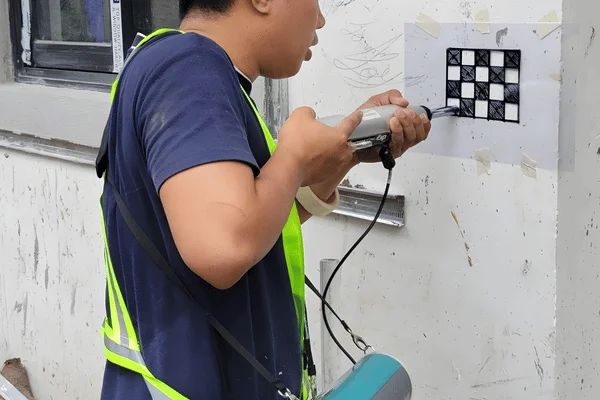
Technicians then perform multiple impacts using the rebound hammer at each selected location. Each impact produces a rebound value that is recorded.
After collecting readings, values from the Rebound Hammer Test are averaged to reduce variation and improve reliability.
The final step involves analysis and reporting. Engineers review the results of the Rebound Hammer Test and compare them with expected strength values and project requirements.
Importance of Rebound Hammer Test in Modern Construction
The Rebound Hammer Test supports modern construction by providing fast and practical evaluation of concrete structures. Construction schedules often require quick decisions, and the Rebound Hammer Test helps engineers assess material condition without delay.
Structural safety depends on early detection of weak concrete areas. The Rebound Hammer Test allows inspection teams to identify potential issues before they develop into serious structural problems.
The Rebound Hammer Test also supports maintenance planning for aging infrastructure. Regular testing helps track changes in concrete condition and supports timely repair decisions.
Construction projects benefit from the Rebound Hammer Test because it reduces the need for destructive sampling during early inspection stages. This helps preserve structural elements while still gathering essential quality data.
Takeaway
The Rebound Hammer Test remains a practical and widely used method for evaluating concrete surface hardness and estimating compressive strength. Its non-destructive nature, speed, and ease of application make it suitable for both construction quality control and structural assessment.
Although the Rebound Hammer Test has limitations related to surface conditions and indirect measurement, it remains valuable when combined with proper standards and supporting testing methods.
Accredited laboratories such as Inch-On Materials Testing Laboratory play a key role in delivering accurate Rebound Hammer Test results that support safe and reliable construction practices.
FAQ: Rebound Hammer Test
What is the main purpose of the Rebound Hammer Test?
The Rebound Hammer Test estimates surface hardness and provides an indirect indication of concrete compressive strength without damaging the structure.
Is the Rebound Hammer Test accurate for all concrete conditions?
The Rebound Hammer Test provides estimates only. Accuracy may vary depending on surface condition, moisture, and age of concrete. Confirmation through other tests may be required.
What structures can be tested using the Rebound Hammer Test?
The Rebound Hammer Test can be applied to slabs, beams, columns, walls, and other concrete structural members.
Does the Rebound Hammer Test damage concrete?
The Rebound Hammer Test is non-destructive and does not cause structural damage when performed correctly.
What standard governs the Rebound Hammer Test?
ASTM C805 defines the standard procedure for conducting and interpreting the Rebound Hammer Test.
Why is the Rebound Hammer Test important in construction projects?
The Rebound Hammer Test helps engineers quickly assess concrete condition, detect weak areas, and support quality control during construction and maintenance.